


The cost of random access memory (RAM) has become a burning concern for Indian tech consumers, builders, and businesses in 2025. What was once an affordable upgrade for computers and laptops has transformed into a premium expense. If you’ve noticed that upgrading your system’s increasing RAM prices have skyrocketed, you’re not imagining it—this is a real, measurable phenomenon reshaping the entire tech ecosystem in India.
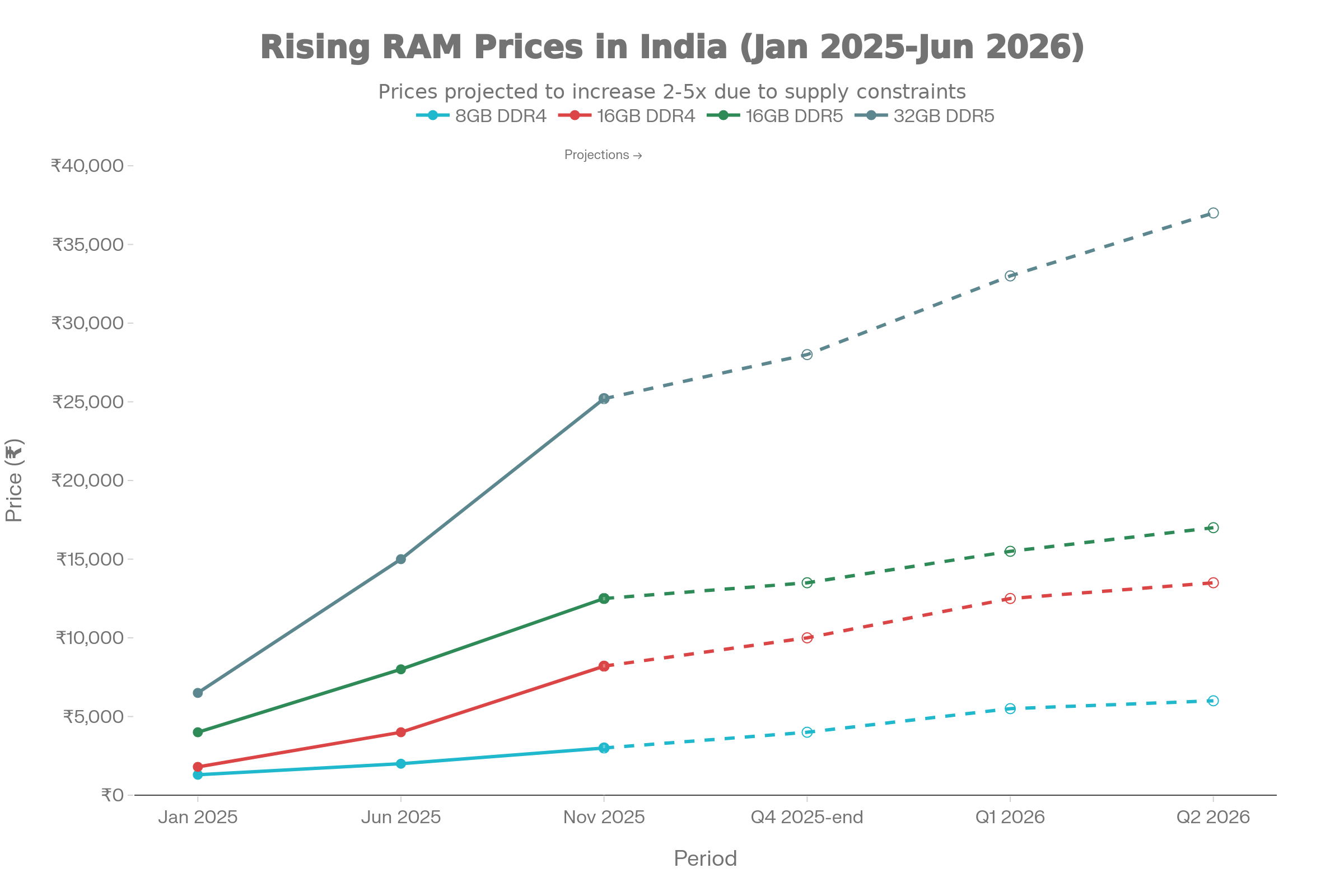
In just eleven months (January to November 2025), mainstream 8GB DDR4 modules jumped from approximately ₹1,300 to over ₹3,000, representing a 130% increase. But this is merely the surface-level observation. The deeper truth behind increasing RAM prices in India involves a complex global semiconductor supply chain crisis, driven primarily by artificial intelligence (AI) data center demand, manufacturing capacity reallocation, and currency depreciation. Understanding these root causes is essential for anyone planning hardware investments or managing technology budgets.
This article deconstructs the mechanisms driving increasing RAM prices, explores their ripple effects across the Indian market, and provides insights into what consumers and businesses should expect in 2026 and beyond.
The Scale of the Crisis: Understanding the Magnitude of Increasing RAM Prices
Before diving into causes, it’s crucial to grasp the scale of increasing RAM prices in India. The numbers are startling for anyone who purchased RAM during the “golden era” of cheap memory between 2019 and early 2024.
Price Escalation Data
| RAM Type & Capacity | January 2025 Price (₹) | November 2025 Price (₹) | Projected 3–6 Month Price (₹) | Total Increase % |
|---|---|---|---|---|
| 8GB DDR4 3200MHz | ~1,300 | ~3,000+ | ~5,200–6,600 | 130% |
| 16GB DDR4 3200MHz | ~1,800 | ~8,200+ | ~11,000–14,000 | 356% |
| 32GB DDR4 3200MHz | ~4,000 | ~15,000+ | ~17,500–21,000 | 275% |
| 16GB DDR5 5600MHz | ~4,000 | ~12,500+ | ~14,000–17,000 | 212% |
| 32GB DDR5 5600MHz | ~6,500 | ~25,200+ | ~30,000–37,000 | 287% |
Key Insight: Higher-capacity modules (16GB and above) are experiencing more severe price escalation than basic 8GB variants. A 32GB DDR4 kit that cost ₹4,000 in January 2025 now commands ₹15,000+—a level last seen in March 2018, before prices collapsed to historic lows.
For context, the long-term average price for an 8GB DDR4 module in India is approximately ₹4,100, suggesting the 2025 spike has already restored prices toward their “normal” range after an unusually cheap decade-long phase.
Primary Cause: AI Demand and High-Bandwidth Memory (HBM) Reallocation
The fundamental driver of increasing RAM prices is neither a physical shortage of silicon nor manufacturing disasters. Instead, it’s a strategic reallocation of scarce production capacity—driven by explosive demand for artificial intelligence infrastructure.
How AI Is Consuming RAM Supply
Modern AI data centers, particularly those training large language models and running inference workloads, require colossal amounts of high-bandwidth memory (HBM). Companies like Nvidia, Google, Microsoft, and Amazon are deploying hundreds of thousands of GPU clusters, each equipped with enormous memory pools.
A single top-tier GPU (such as Nvidia’s H100 or H200) can consume up to 1TB of HBM. When a data center deploys thousands of GPUs, the aggregate memory demand reaches exabyte scales. This creates unprecedented competition for wafer capacity at foundries operated by Samsung, SK Hynix, and Micron.
The critical issue is supply asymmetry: Wafer capacity is finite and requires years to scale. HBM production consumes approximately three times the wafer capacity of DDR5 RAM per gigabyte of memory produced. Manufacturers, facing a choice between producing high-margin HBM for AI customers (who pay premium prices with long-term contracts) and commodity DDR memory for consumer markets, have systematically reallocated capacity toward HBM.
This reallocation directly triggered increasing RAM prices in India because India imports nearly 100% of its DRAM—meaning Indian consumers depend entirely on global supply allocations.
The Manufacturing Pivot: DDR4 Phase-Out
The situation was further exacerbated by a coordinated industry decision to discontinue DDR4 production. In 2024 and through 2025, major manufacturers including Samsung, SK Hynix, and Micron announced formal plans to halt DDR4 fabrication, reallocating equipment and cleanroom capacity to more profitable DDR5 and HBM production lines.
This phase-out created a paradox: Although DDR4 demand remains strong (particularly in budget and mid-range systems), production is deliberately being wound down. Manufacturers face no economic incentive to operate low-margin DDR4 fabs when HBM commands prices 4–5x higher per die.
The Micron Crucial Consumer Exit
In December 2025, Micron announced the complete discontinuation of its Crucial consumer brand—a brand that had supplied affordable RAM directly to PC builders for 30 years. The company explicitly stated that the AI-driven growth in data centers led to a surge in demand for memory, prompting Micron to exit the consumer business to support larger, strategic customers in faster-growing segments.
This move symbolizes the broader market reshuffling. Micron, one of only three major DRAM manufacturers globally, is abandoning consumer markets entirely to focus on HBM and enterprise DRAM for AI data centers. This consolidation of capacity further restricts consumer supply and perpetuates increasing RAM prices.
Secondary Cause: Production Capacity Reallocation and Yield Constraints
Beyond the AI-driven demand surge, increasing RAM prices are also driven by structural production challenges.
Wafer Capacity Crunch
Total wafer production across Samsung, SK Hynix, and Micron has not expanded proportionally with overall DRAM demand. Instead, what has occurred is a redistribution of fixed capacity. Bit demand (total memory volume) across all applications is projected to grow in the 18–20% range through 2026, while physical production capacity growth is limited to the mid-10% range. This supply-demand imbalance ensures persistent upward price pressure.
Cloud providers are consuming up to 40% of global DRAM output, further restricting consumer availability. Memory now comprises 10–15% of server costs, and the increasing RAM prices directly amplify data center infrastructure expenses.
Manufacturing Complexity and Yield Issues
DDR5 and HBM require significantly more advanced process nodes and complex validation procedures than DDR4. These newer memory types demand advanced process nodes, rigorous thermal testing, sophisticated power management ICs (PMICs), and longer production lead times. These complexities create bottlenecks that slow the ramp-up of new capacity, directly contributing to increasing RAM prices in India and globally.
The Secondary Impact: Rupee Depreciation and Import Cost Inflation
While AI-driven supply reallocation is the primary driver of increasing RAM prices, a secondary factor amplifies the problem for Indian consumers: the depreciation of the Indian rupee against the U.S. dollar.
Currency Headwinds
The Indian rupee has weakened to record lows, trading near ₹91 per U.S. dollar as of December 2025. This depreciation stems from widening trade deficits, foreign institutional investor (FII) outflows totaling ₹1.48 lakh crore in 2025, U.S. tariff uncertainty under the Trump administration (up to 50% tariffs on Indian goods), and capital flight to safer asset classes.
Critical Insight: The increasing RAM prices experienced by Indian consumers reflect a combination of genuine global supply constraints (70–75% of the price rise) and currency headwinds (15–20%), with the remainder attributable to retailer margins and inventory buildup.
Impact on Indian Consumers and Businesses: The Cascade Effect
The ramifications of increasing RAM prices extend far beyond individual tech enthusiasts. The effects cascade through the entire Indian technology ecosystem.
Consumer-Grade Impact
| Segment | Impact Level | Examples |
|---|---|---|
| PC Builders & Enthusiasts | Severe | 16GB kits now cost ₹8,200+; basic PC builds 40–50% more expensive |
| Students & Budget Buyers | Critical | Entry-level laptops now ₹5,000–10,000 more expensive |
| Gaming Community | Severe | High-capacity RAM configurations economically unfeasible |
| Content Creators | Moderate-Severe | 32GB+ systems cost ₹75,000–1,20,000+ (vs ₹40,000–60,000 previously) |
| Small Business & SMEs | Moderate | Delayed hardware refresh cycles; operational cost increases |
Impact on Device Pricing
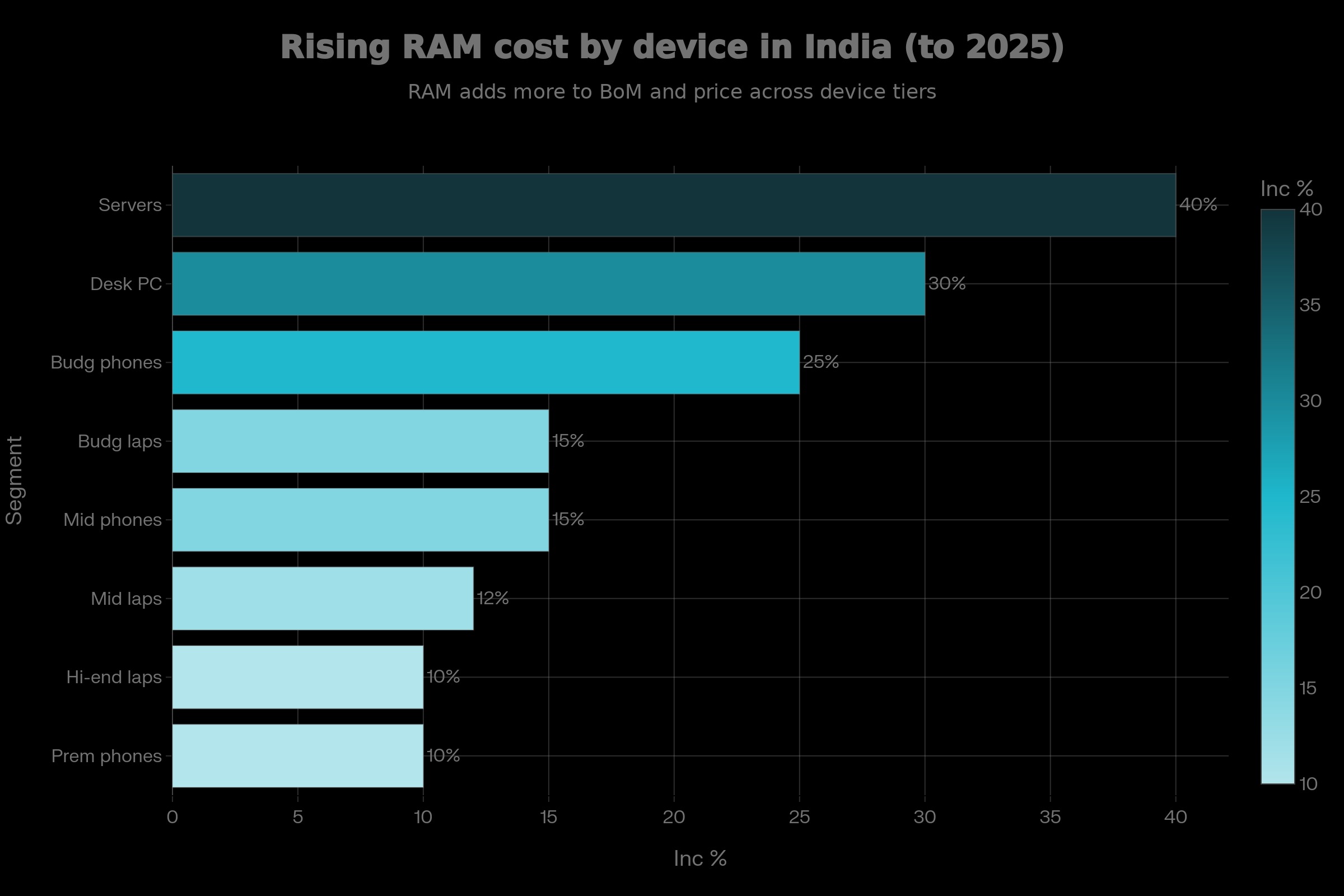
Smartphones: DRAM accounts for 10–15% of smartphone bill-of-materials (BoM). Across device tiers, DRAM price surges have already increased BoM costs by 25% for budget devices, 15% for mid-range, and 10% for premium segments. OEMs are responding by either absorbing costs (squeezing margins) or increasing retail prices by 10–15%. High-end phones that cost ₹50,000–60,000 in late 2024 now launch at ₹70,000+.
Laptops: Laptop manufacturers face BoM increases of 12–18%, leading to retail price hikes of 10–15%. A mid-range laptop (₹60,000–80,000) now costs ₹66,000–92,000.
Enterprise and Server Impact
The situation is most acute in enterprise segments. Server-grade DRAM (RDIMM modules with high density) has seen price increases of 30–50%. Data center operators and cloud service providers in India are seeing project economics deteriorate. Enterprise customers are delaying hardware procurements, reconsidering capacity plans, reducing order volumes, and deferring expansion decisions.
Future Outlook: When Will Increasing RAM Prices Stabilize?
The forecast for increasing RAM prices through 2026 and beyond reveals a prolonged period of elevated costs.
Timeline for Price Relief
Q4 2025 – Q1 2026: Continued price increases of 20–30%, DDR5 and DDR4 shortages most acute, enterprise procurement stalled, consumer purchasing deferred.
Q2 2026 – Q3 2026: Potential cumulative increases of 50% from current levels, some new capacity coming online at advanced node fabs in Taiwan, HBM demand potentially plateauing, first signs of relief possible but not guaranteed.
Late 2026 – 2028: New fabs in India (Micron’s Sanand facility, Tata-PSMC) ramping to commercial production, global capacity exceeding demand growth, gradual price normalization expected. However, prices unlikely to return to pre-2024 lows; new baseline approximately 30–50% above those levels.
Structural Changes to Expect
The long-term memory market will likely experience permanent changes: reduced consumer allocation from manufacturers, higher baseline prices, increased DDR5 adoption, server-centric supply focus, and regional supply fragmentation with India’s new fabs preferentially serving domestic and regional markets.
Conclusion: The Reality of Increasing RAM Prices and What It Means
The increasing RAM prices in India are neither a temporary anomaly nor a simple supply shortage. Instead, they represent a structural realignment of the global semiconductor industry in response to artificial intelligence’s explosive infrastructure demands.
Key Takeaways:
- Primary Driver: AI data centers’ demand for HBM, causing manufacturers to reallocate production capacity from consumer DRAM
- Secondary Driver: Rupee depreciation amplifying import costs
- Severity: 130–356% price increases for mainstream modules (8GB–32GB) since January 2025
- Duration: No relief expected before Q2 2026; meaningful price stabilization unlikely before 2027–2028
- Impact Scope: Affects smartphones, laptops, desktops, servers, and entire enterprise IT infrastructure
- India-Specific Risk: Domestic manufacturing gap and high price sensitivity amplify local impact
Visual Analysis